
Case based
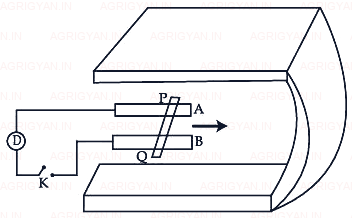
Figure shows a metal rod PQ resting on the rails AB and positioned between the poles of a permanent magnet. The rails, the rod and the magnetic field are in three mutually perpendicular directions. A galvanometer G connects the rails through a switch K. Length of the rod $= 15\,\text{cm}$, $B = 0.50\,\text{T}$, resistance of the closed loop containing the rod $= 180.0\,\text{m}\Omega$. Assume the field to be uniform.
The induced emf produced in the moving rod if the magnetic field becomes parallel to the rails instead of being perpendicular will be :
केस आधारित प्रश्न
चित्र में एक धातु की छड़ PQ पटरियों AB पर रखी हुई है तथा एक स्थायी चुंबक के ध्रुवों के बीच स्थित है। पटरियाँ, छड़ तथा चुंबकीय क्षेत्र तीन परस्पर लंबवत दिशाओं में हैं। एक गैल्वेनोमीटर G स्विच K के माध्यम से पटरियों को जोड़ता है। छड़ की लंबाई $= 15\,\text{cm}$, $B = 0.50\,\text{T}$, छड़ युक्त बंद लूप का प्रतिरोध $= 180.0\,\text{m}\Omega$ है। क्षेत्र को एकसमान मानिए।
यदि चुंबकीय क्षेत्र लंबवत होने के बजाय पटरियों के समांतर हो जाए, तो गतिमान छड़ में उत्पन्न प्रेरित विद्युत वाहक बल होगा :
The general vector formula for motional EMF induced in a conductor of length vector $\vec{l}$ moving with velocity $\vec{v}$ through magnetic field $\vec{B}$ is:
$$\varepsilon = (\vec{v} \times \vec{B}) \cdot \vec{l}$$- The rod moves along the direction of the rails, so velocity vector $\vec{v}$ is parallel to the rails.
- If the magnetic field $\vec{B}$ is also parallel to the rails, then $\vec{v}$ and $\vec{B}$ are collinear (angle $\theta = 0^\circ$ or $180^\circ$).
- Therefore, the cross product $\vec{v} \times \vec{B} = 0$, giving an induced EMF of:
गतिक विद्युत वाहक बल का सदिश व्यंजक:
$$\varepsilon = (\vec{v} \times \vec{B}) \cdot \vec{l}$$- छड़ पटरियों के अनुदिश गतिमान है, अतः इसका वेग सदिश $\vec{v}$ पटरियों के समांतर है।
- यदि चुंबकीय क्षेत्र $\vec{B}$ भी पटरियों के समांतर हो जाता है, तो $\vec{v}$ और $\vec{B}$ परस्पर समांतर हो जाएंगे (कोण $\theta = 0^\circ$)।
- अतः सदिश गुणन $\vec{v} \times \vec{B} = 0$ होगा, जिसके कारण प्रेरित विद्युत वाहक बल शून्य हो जाएगा: