
Case based
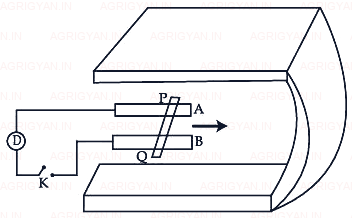
Figure shows a metal rod PQ resting on the rails AB and positioned between the poles of a permanent magnet. The rails, the rod and the magnetic field are in three mutually perpendicular directions. A galvanometer G connects the rails through a switch K. Length of the rod $= 15\,\text{cm}$, $B = 0.50\,\text{T}$, resistance of the closed loop containing the rod $= 180.0\,\text{m}\Omega$. Assume the field to be uniform.
The power dissipated as heat in the closed circuit is :
केस आधारित प्रश्न
चित्र में एक धातु की छड़ PQ पटरियों AB पर रखी हुई है तथा एक स्थायी चुंबक के ध्रुवों के बीच स्थित है। पटरियाँ, छड़ तथा चुंबकीय क्षेत्र तीन परस्पर लंबवत दिशाओं में हैं। एक गैल्वेनोमीटर G स्विच K के माध्यम से पटरियों को जोड़ता है। छड़ की लंबाई $= 15\,\text{cm}$, $B = 0.50\,\text{T}$, छड़ युक्त बंद लूप का प्रतिरोध $= 180.0\,\text{m}\Omega$ है। क्षेत्र को एकसमान मानिए।
बंद परिपथ में ऊष्मा के रूप में क्षय होने वाली शक्ति है :
By the law of conservation of energy, the entire mechanical power supplied by the external agent to move the rod against the magnetic Lorentz force is converted into electrical energy and subsequently dissipated as Joule heat in the loop resistance:
$$P_{\text{heat}} = I^2 R = \frac{\varepsilon^2}{R}$$ $$P_{\text{heat}} = 4.5 \times 10^{-3}\,\text{W}$$ऊर्जा संरक्षण के नियमानुसार, छड़ को एकसमान चाल से गतिमान रखने के लिए बाह्य कारक द्वारा प्रदान की गई संपूर्ण यांत्रिक शक्ति विद्युत ऊर्जा में तथा अंततः प्रतिरोध में जूल ऊष्मा के रूप में क्षय हो जाती है:
$$P_{\text{heat}} = I^2 R = \frac{\varepsilon^2}{R} = 4.5 \times 10^{-3}\,\text{W}$$